

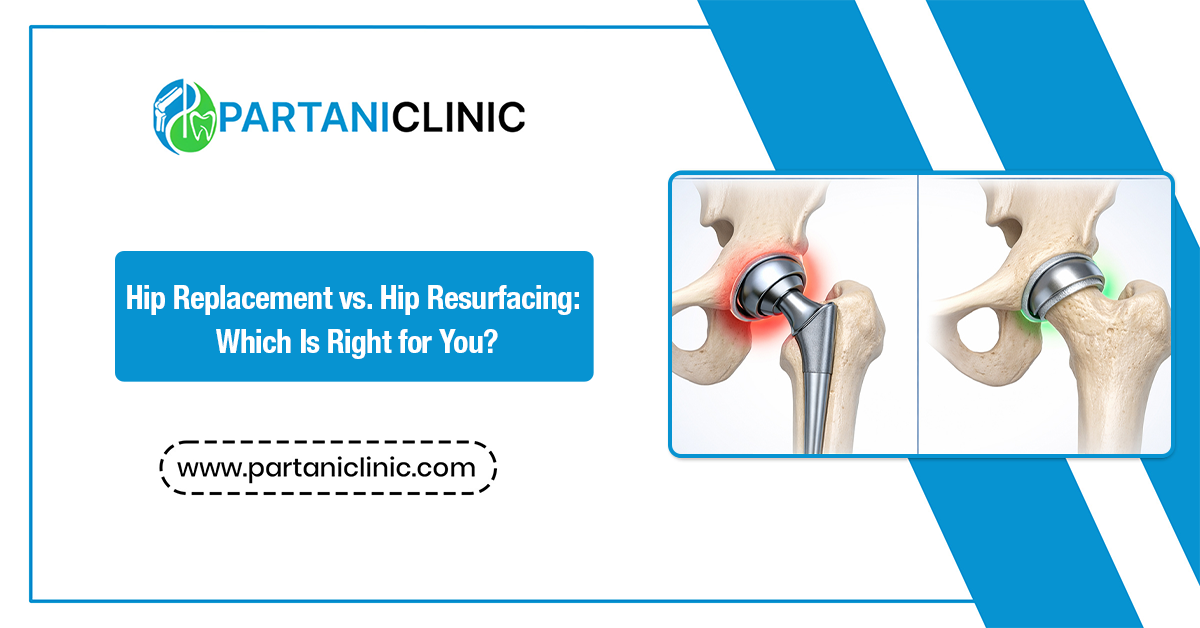
When hip pain starts making simple things like walking, climbing stairs, or getting out of a chair difficult, you may eventually hear about two surgical options: hip replacement and hip resurfacing. Both are meant to improve a painful, damaged hip, but they work differently. So, which is better hip replacement or resurfacing? The answer depends on your age, bone strength, hip condition, and daily activity level.
Hip Replacement vs Hip Resurfacing: Key Differences
| Hip Replacement | Hip Resurfacing |
| The damaged ball of the hip is removed and replaced with an artificial one. | The natural ball is kept and covered with a metal cap. |
| The damaged socket is also replaced. | The damaged socket is replaced. |
| It can be suitable for a wide range of patients with severe hip damage. | It is mainly considered for carefully selected patients with good bone quality. |
| It is commonly used for advanced arthritis and other serious joint problems. | It may be considered for some younger, active patients. |
| There is no femoral neck fracture risk from the resurfacing cap itself. | Femoral neck fracture is one of the possible complications. |
| It has a long history of use and well-established results. | It has specific limitations and is not suitable for everyone. |
When Might Hip Replacement Be the Better Choice?
Someone with severe damage to the hip is more practical for hip replacement. It is a well-established procedure and can provide significant pain relief when other treatments have failed. Some Hip replacement benefits include:
- Hip pain is affecting normal daily activities
- Arthritis has become advanced
- Hip movement has become very limited
- Medicines or physiotherapy are no longer providing enough relief
Who May Be Considered for Hip Resurfacing?
Hip resurfacing is not simply a “better” version of hip replacement. It is an option for selected patients, and bone quality is particularly important.
It may be considered when a person:
- Is relatively young and physically active
- Has good bone strength
- Has suitable hip anatomy
- Does not have conditions that make resurfacing unsafe
Your surgeon will need to look at your X-rays and overall health before deciding whether it is appropriate.
What About Recovery after replacement?
After hip replacement surgery, recovery is part of either procedure, but it shouldn’t be the only reason to choose one procedure over the other. Patients usually start moving early and gradually build strength with physiotherapy.
The speed of hip replacement recovery can depend on age, fitness, overall health, and how well the rehabilitation plan is followed.
You might have to:
- Begin with gentle movements
- Gradually add walking
- Do your physio exercises
- Avoid activities your surgeon has put on hold for now
- Allow your body enough time to heal
Resurfacing also involves rehabilitation, so just because you have a different surgical technique doesn’t mean there is no recovery period.
What to consider before choosing?
This is not a decision to be taken lightly, and be aware that your surgeon will consider factors other than your age or activity level. Important considerations include:
- Quality of bone: This is very important, particularly if you are considering a resurfacing
- procedure.
- Type of hip damage: The severity and type of damage can also influence the best procedure.
- Lifestyle: Tell your surgeon what activities you enjoy and what you plan to do for future activities.
- General health: If you have other health problems, you may not be a candidate for some of the procedures.
Which Is Better Hip Replacement or Resurfacing?
For one person, resurfacing may be a reasonable option because of their age, activity level, and strong bone. For another, replacement may be safer and more suitable because of the condition of the hip or weaker bone.
That is why the decision should come after an examination and appropriate imaging rather than simply choosing the procedure that sounds less invasive.
If you are considering Hip Replacement Surgery In Jaipur, speak with an experienced orthopaedic surgeon about both options. Ask what would work best for your hip, what the possible risks are, and what you can expect from recovery.
Final Takeaway
Both procedures have their place. Hip resurfacing preserves more of the natural femoral bone, while hip replacement is a widely used option for people with significant hip damage. So finding out which is better hip replacement or resurfacing, is not important. The real question is not which surgery is better for everyone. It is which procedure is the better fit for your hip, your health, and your everyday life.